
Who created the haka? This fierce, intimidating, ceremonial dance is certainly one to remember but do we even know where it started? It can be seen on the football fields performed by college football players at the University of Hawaii or at the Rugby World Cup. Its origin can often be confused as it has spread across Polynesian cultures. This dance has been considered controversial as various ethnicities perform the haka. The haka started New Zealand’s very own Maori, a rich, native culture of the island. Both Hawaiian and the Maori culture are rich and unique. This blog will explore why it can be easy to confuse New Zealand and Hawaii as well as explore how they are different.

This blog will look at the similarities and differences between Hawaii and New Zealand. I specifically chose Hawaii because I am moving to Oahu at the end of this year and I am wanting to learn as much as possible about the culture. I have been confused and have heard others confuse the cultures of their native people although they are nearly 5,000 miles and an ocean apart. Geographically speaking, New Zealand is nearly ten times the size of Hawaii. The map below demonstrates the difference in size of the islands.
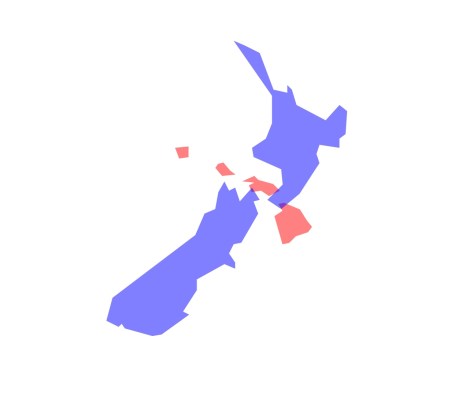
Native Hawaiians and New Zealand’s Māori people have quite a few things in common. For starters, both are a collection of islands with active volcanoes. Both cultures are rich in art, music, and dance. The Māori and Hawaiian languages both heavily use vowels in their word structure and are branches of Polynesian language.
Tattoos are also seen in both cultures but represent different things. For example, tattoos among the Hawaiians are referred to as kakua. Tattoos among the Māori are referred to as moko. Full torso and full face moko was common and represented their ancestry and ranking. They consisted of many spirals while kakua depicted nature with lizards, plants, and intricate patterns.
LOCATION
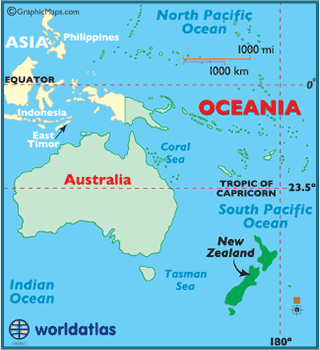
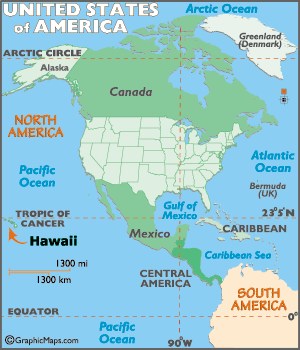
New Zealand is located just below Australia in the South Pacific Ocean and is its own country. Hawaii is the 50th state recently added in 1959 to the United States of America and is also located in the central Pacific Ocean.

PLACE
Comparing the Land
Hawaii is a cluster of eight larger islands and over one hundred smaller islands in the Pacific ocean while New Zealand has only two larger islands and over seven hundred small islands. Both the shape and terrain of the Hawaii and New Zealand are much different from one another although there are rainforests on the South Island of New Zealand that are strikingly similar to Hawaii’s rainforests (Walrond, 2005). The North Island of New Zealand is primarily rolling hills used for crop growing and large sections of forestry. Both Hawaii and New Zealand consists of a collection of islands that have active and inactive volcanos. Hawaii’s Kilauea volcano is currently the most famous as it has caused a significant amount of destruction on the Big Island in its most recent eruption. As destructive as these active volcanos can be, they are responsible for forming the land of both of these magnificent places (McSaveney, 2015; Wayman, 2011). The soil in many areas of both places are made rock, formed from the once flowing lava.
Climate
It is notoriously known that it feels like summer year round in Hawaii. Lesser known is that there are actually two seasons: summer and winter. Although winter in Hawaii does not come close to fitting the typical winter characteristics we typically think of, there are some unique things that make winter in Hawaii. Rainfall is heaviest in Hawaii during the winter months from approximately October through March and on the highest peaks, dustings of snow have fallen (Giambelluca, Chen, Price, Chen, Chu, Eischeid, & Delparte 2013). The currents also change and are much stronger in the winters. Often times, beaches on the northern side of the islands are shut down because the shore break is so strong that it can and has been fatal. Although there are only a few degrees difference in temperature between summer and winter in Hawaii, there are a number of climate changes that contribute to making a winter in Hawaii a season.
In New Zealand, climate varies much more than in Hawaii. In northern parts of the island, it is warmer weather and subtropical while staying cooler in the souther parts (Mackintosh, 2001). Like Hawaii, rainfall dramatically increases in the winter time. However, the climate in New Zealand is considered rather unstable as Antartica’s cold dry air clashes with the tropic’s warm moist air creating high pressure systems (Walrond, 2005). In fact, the weather is so capricious, one New Zealand explorer said “it is quite possible to experience four seasons in one day” (Walrond, 2005).
The Views
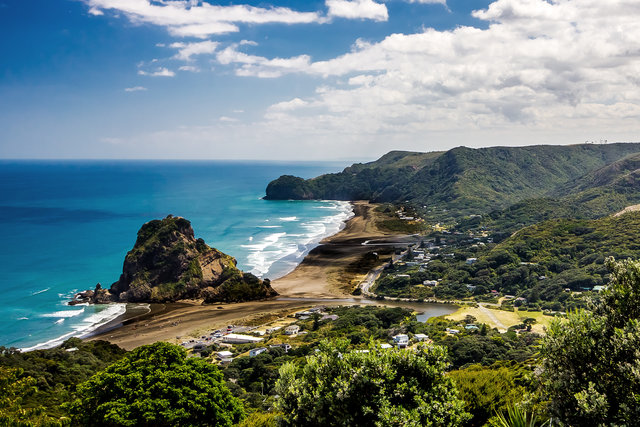
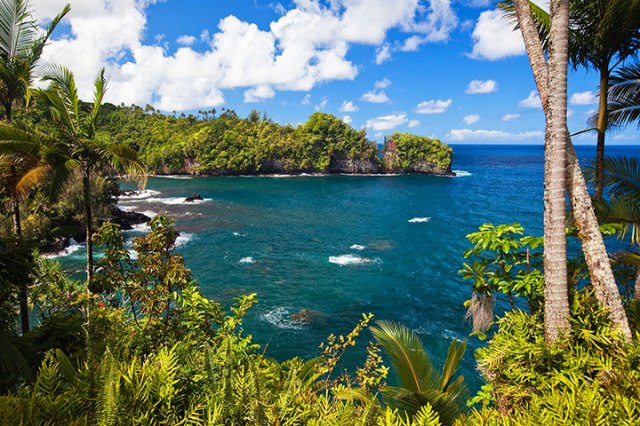
Islands always have a particular feel to them. “Island fever” captures the hearts of millions of tourists every years who visit Hawaii and New Zealand. A major reason for this is the view of the ocean. In the northern and western coasts of New Zealand, the water tends to stay warmer (Walrond, 2005). Like Hawaii, the coasts of New Zealand are home to a plethora of unique underwater life such as countless species of fish, dolphins, whales, and penguins.
HUMAN-ENVIRONMENT INTERACTION
Consumption
Agriculture and fishing are huge in both New Zealand and the Hawaiian islands. Surrounded by such vast seas makes fishing an easy capitol. A study done in 2013 revealed that 90% of their food is imported (Loke & Leung, 2013). This leads to many concerns and a harsh environmental impact as heavy cargo ships travel back and forth from the mainland. New Zealand is quite the contract in this aspect as they are completely self sustainable and 18% of their exported items are food (Walrond, 2013). New Zealand has one of the world’s most reliable and abundant food systems as they have a large amount of farm land, seas to fish from, and forests to harvest from.
MOVEMENT
Getting to these islands is fairly straightforward as there is only one way: aircraft. There are large cargo ships that move from the islands to the mainlands but it is not a way to travel as these ships can take up to a week just going one way. So airlines are pretty much the only option. Once on an island in Hawaii, you must also fly to travel to one of the other islands as there are no boats that carry people from island to island. New Zealand’s islands, however, are much closer to each other so taking a three and a half hour ferry ride is an option (Walrond, 2013).
The People
Hawaii is commonly thought of as a paradise, the American get-a-way without actually leaving the country. It is capitalized upon across the entire country. The word “Aloha” is loosing its true meaning as a result of this. Aloha is sort of a sticker for the Hawaiian culture. It represents their spirit, kindness, appreciation towards one another and community. As mentioned at the beginning of this blog, the Maori people of New Zealand and the Hawaiians share many similarities as they both fall into the Polynesian triangle. Language, apparel, traditions, and so much more share many similarities. The Hawaiian and Maori language are composed of primarily vowels and there are songs and music in both cultures that have been passed down through generations.
New Zealand’s population as of September 18th, 2018 is estimated to be around 4.9 million people (NZ Stats). As of February 2018, New Zealand’s birth rates were at an all time low according to their government statistics at 1.81 births on average per woman (NZ Stats). In 2018, the birth rate increased to 2.18 births on average per woman.
Hawaii’s population in the 2017 census was approximated to be over 1.4 million people.
Works Cited
Births and deaths: Year ended September 2018 – Infoshare tables, 2018. Retrieved from https://www.stats.govt.nz/information-releases/births-and-deaths-year-ended-september-2018-infoshare-tables.
Giambelluca, T.W., Chen, Q., Frazier, A.G., Price, J.P., Chen, Y.-L., Chu, P.-S., Eischeid, J.K., and Delparte, D.M., 2013. Online Rainfall Atlas of Hawai‘i. Bull. Amer. Meteor. Soc. 94, 313-316, doi: 10.1175/BAMS-D-11-00228.1.
“Hawaii,” worldatlas, Retrieved from https://www.worldatlas.com/webimage/countrys/namerica/usstates/hi.htm.
Loke, M.K., Leung, P., 2013. Hawai‘i’s food consumption and supply sources: benchmark estimates and measurement issues. Agricultural and Food Economics. Springer. Retrieved from https://doi.org/10.1186/2193-7532-1-10.
Mackintosh, L., 2001. Overview of New Zealand’s climate. NIWA. Retrieved from https://www.niwa.co.nz/education-and-training/schools/resources/climate/overview
MapFight. Retrieved from https://mapfight.appspot.com/us.hi-vs-nz/hawaii-us-new-zealand-size-comparison.
“New Zealand,” worldatlas, Retrieved from https://www.worldatlas.com/webimage/countrys/oceania/nz.htm.
Pacific Islanders in Communications. Skin Stories: The Art and Culture of Polynesian Tattoo. PBS, 2003, Retrieved from https://wordpress.com/post/globalresearch.video.blog/11.
Shütz, A.J. (January 1, 1994). The Voices of Eden: A History of Hawaiian Language Studies. University of Hawaii Press. Retrieved from http://www.ulukau.org/elib/cgi-bin/library?e=d-0voicesofeden-000Sec–11en-50-20-contact-book–1-010escapewin&a=d&d=D0.18&toc=0.
McSaveney, E. (2015). ‘Landscapes – overview.’ Te Ara – the Encyclopedia of New Zealand. Retrieved from http://www.TeAra.govt.nz/en/landscapes-overview (accessed 25 November 2018).
Stafford, J., 2015. The All Blacks’ haka: Best, worst and most bizarre. The Telegraph: Front Row. Retrieved from https://www.telegraph.co.uk/sport/rugbyunion/rugby-world-cup/front-row/11868580/The-All-Blacks-haka-Best-worst-and-most-bizarre.html.
United States Census Bureau, 2017. Retrieved from https://www.census.gov/quickfacts/hi
Walrond, C., 2005, Natural environment – Climate. Te Ara – the Encyclopedia of New Zealand. Retrieved from http://www.TeAra.govt.nz/en/natural-environment/page-3.
Wayman, E (December 2011). What We’re Still Learning About Hawaii: The fiery forces beneath the island chain still mystify geologists. Smithsonian Magazine. Retrieved from https://www.smithsonianmag.com/travel/what-were-still-learning-about-hawaii-74730/#Xloe2tBJbUhvB1me.99
 Hawaii and New Zealand